

There are stories that begin with conflict.
This is not one of them.
This story began with trust.
Trust that a multinational financial institution would maintain accurate records. Trust that written confirmations meant something. Trust that when a company says, “You have been removed from our system,” that statement reflects reality—not only internally, but also in the information provided to regulators.
That trust is what makes this story worth telling.
Because when trust disappears from financial services, everything else begins to crumble with it.
Why I Am Writing This
I do not usually write publicly about business disputes.
I prefer writing about entrepreneurship, technology, society, charity, media and the lessons we learn through life.
But every now and then, an experience raises questions that go beyond one person or one invoice.
This is one of those experiences.
The question is simple:
How accountable is a multinational company when its written confirmations conflict with the information later communicated to a financial regulator?
That deserves attention.
Not because I am looking for sympathy.
Because the facts matter.
How It Began
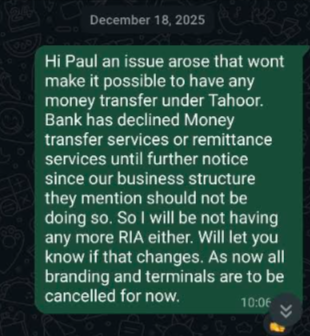
Towards the end of 2025, MoneyGram contacted me because they wanted me to become one of their agents in Norway.
The onboarding process started.
Documents were exchanged and the registration process was initiated.
Before the process was completed, I decided that I did not wish to continue.
Business decisions change. That is normal.
I informed MoneyGram that I wanted the process stopped and asked to be removed from their system.
I was told that I had been removed.
At that point, I believed the matter was closed.
The February Confirmation
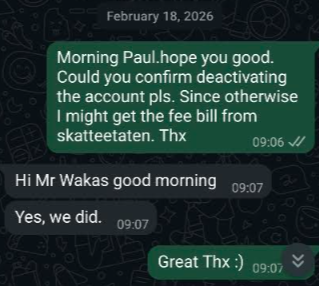
In February 2026, I contacted the person responsible for MoneyGram in Norway to make sure that I had, in fact, been removed.
He confirmed in writing that I was no longer in their system.
That confirmation mattered.
Money transfer services operate in a heavily regulated environment. A person should not have to guess whether they remain connected to a financial institution after being told that the relationship has ended.
By February 2026, there was no uncertainty from my side.
The person responsible for MoneyGram in Norway had confirmed that I had been removed.
I had that confirmation in writing.
There was no reason for me to believe that I remained registered anywhere as a MoneyGram agent.
Then the Invoice Arrived
Months later, I received a letter from Finanstilsynet, Norway’s Financial Supervisory Authority.
Inside was an invoice for 10,000 Norwegian kroner.
According to Finanstilsynet, I was still listed in connection with MoneyGram.
I read the letter more than once.
Not because it was difficult to understand.
Because it did not match what MoneyGram had already told me.
MoneyGram had confirmed that I was removed.
Finanstilsynet’s records indicated otherwise.
Both versions could not be correct.
What Happened After I Asked MoneyGram to Correct It
I contacted the person responsible for MoneyGram in Norway and asked him to correct the mistake.
I expected a straightforward response.
MoneyGram had already confirmed in February 2026 that I had been removed. The logical next step would have been to communicate that fact clearly to Finanstilsynet and correct the record.
Instead, he sent an email to Finanstilsynet stating that:
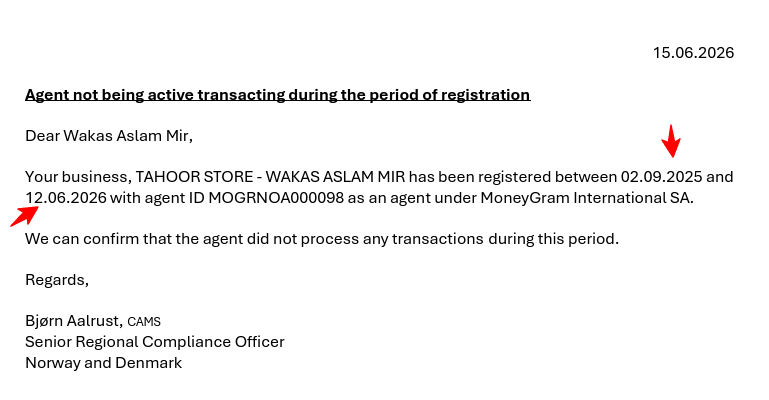
“Wakas has been with us till June 2026.”
That statement directly contradicted the confirmation I had already received from him in February 2026.
This is not a matter of interpretation.
In February, I was told in writing that I had been removed.
After I asked him to correct the situation, Finanstilsynet was told that I had remained with MoneyGram until June.
Those are two different timelines.
Both cannot be true.
Why the Date Matters
Some may look at this and think the difference between February and June is only a few months.
It is not.
That difference had a financial consequence.
If I was removed in February, as MoneyGram confirmed, then that should have been reflected in the information MoneyGram maintained and communicated.
If Finanstilsynet was later told that I remained with MoneyGram until June, that created a version of events that did not match the written confirmation already given to me.
This is not simply an administrative detail.
It is the difference between being told that a matter has been closed and later receiving a 10,000 NOK invoice because the regulator apparently had different information.
Dates matter.
Records matter.
Written confirmations matter.
Compliance Is Not a Customer-Service Phrase
Companies often speak about compliance as part of their public image.
They publish policies.
They refer to procedures.
They speak about transparency, governance and responsibility.
But compliance is not a slogan.
It is not a paragraph on a corporate website.
It is a legal and operational responsibility.
When a company communicates with a regulator, accuracy is essential.
When a company tells someone they have been removed, that removal should be reflected everywhere it needs to be reflected.
If it is not, the consequences do not remain inside the company.
They are passed on to someone else.
In this case, they were passed on to me.
What I Expected From MoneyGram
I was not looking for conflict.
I expected MoneyGram to review the written correspondence, compare the dates and correct the discrepancy.
That should have been simple.
The company had the records.
The Norwegian representative had sent the confirmation.
The timeline existed in writing.
Instead of resolving the contradiction, the email sent to Finanstilsynet introduced a June 2026 end date that did not match what I had been told in February.
That did not correct the problem.
It made the contradiction clearer.
This Is About More Than 10,000 NOK
Yes, 10,000 kroner is a significant amount.
But this story is not only about the money.
Money can be earned again.
The larger issue is trust.
Financial institutions expect customers, agents and regulators to trust their systems.
They expect people to rely on their written communication.
They expect others to follow procedures, respect dates and provide accurate information.
That responsibility must work both ways.
A company cannot demand precision from everyone around it while treating its own written confirmations as if they carry no weight.
Why Keeping Records Matters
I have always believed in keeping documentation.
Emails.
Messages.
Invoices.
Dates.
Confirmations.
That habit matters because large organisations often deal with issues through different departments, different employees and different versions of the same timeline.
Without documentation, an individual is left trying to prove what was said.
In this case, I do not need to rely on memory.
The February confirmation exists.
The later email to Finanstilsynet exists.
The invoice exists.
The contradiction is documented.
The Responsibility of Leadership
Every organisation makes mistakes.
That alone does not define a company.
What defines a company is what happens after the mistake becomes clear.
Does leadership investigate?
Does the company compare its own records?
Does it acknowledge the contradiction?
Does it correct the financial consequence?
Or does it leave the affected individual to carry the cost?
Leadership is not tested when everything works perfectly.
Leadership is tested when something has gone wrong and responsibility becomes uncomfortable.
Why This Matters Beyond My Case
This case raises a broader question.
How many people trust a written confirmation from a large company and assume the necessary records have been updated?
How many would ever think to check again?
How many would keep every email?
How many would receive an invoice months later and simply pay it because challenging a multinational corporation feels impossible?
That is why I am writing publicly.
Not because I want to dramatise the situation.
Because people should understand that a written confirmation is only valuable if the organisation stands behind it.
An Opportunity for MoneyGram
This article is not an attack on every person working at MoneyGram.
It is an opportunity for the company’s leadership to review what happened.
The facts are available.
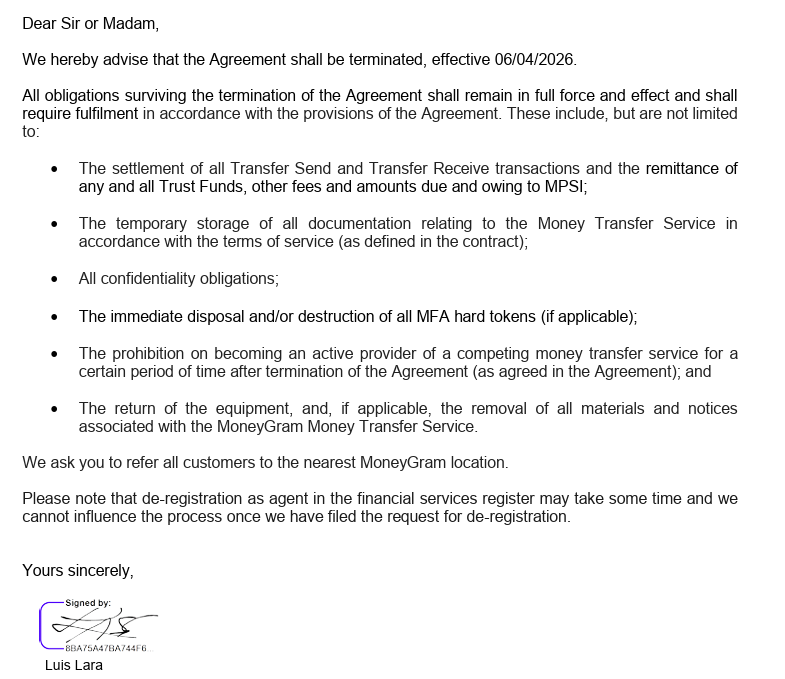
MoneyGram can examine the February confirmation.
It can examine the email later sent to Finanstilsynet.
It can examine the registration history.
It can determine why I was told I had been removed while the regulator later received information stating that I remained with MoneyGram until June 2026.
This does not require speculation.
It requires an honest review of the records.
Final Thoughts
I have spent much of my life believing that integrity is measured by what people do when nobody is watching.
The same principle applies to corporations.
Advertising creates visibility.
Branding creates recognition.
But accountability creates trust.
MoneyGram has the emails.
I have the emails.
Finanstilsynet has the invoice.
The facts already exist.
The only remaining question is whether MoneyGram’s leadership is willing to compare the timeline with its own records and take responsibility for the outcome.
Companies earn trust when everything goes right.
They earn respect when they correct what went wrong.
 |  |