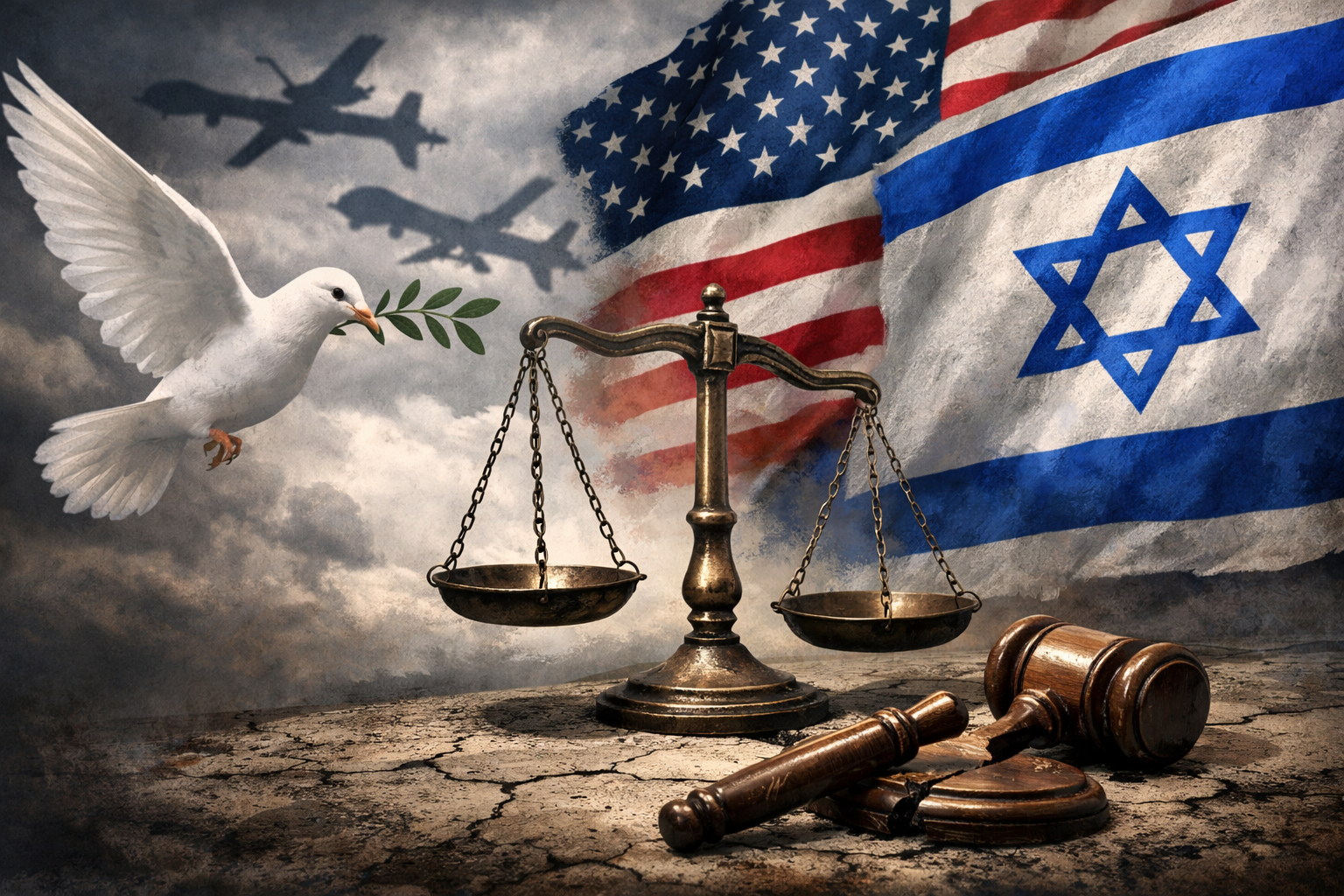

The United States has carried out approximately 469 military interventions between 1798 and 2022. Since 1945 there have been an estimated 70 to 75 regime change attempts, with roughly 40 to 45 successful removals of governments through covert or overt means. Those numbers are not emotional. They are documented.
Yet when America speaks on global stages, the language is almost always the same. Rules based order. International law. Sovereignty. Human rights. Democracy.
The problem is not the words. The problem is the application.
When Washington invades, it is liberation.
When others invade, it is aggression.
When America arms a proxy group, it is strategic support.
When rivals arm a proxy group, it is destabilization.
When the United States maintains military bases across continents, it is partnership.
When another power expands military presence, it is expansionism.
Vocabulary changes depending on the flag.
Now bring in Israel.
Israel has fought major wars in 1948, 1956, 1967 and 1973. It invaded Lebanon in 1982. It struck Iraq’s nuclear reactor in 1981. It has conducted repeated large scale military operations in Gaza in 2008, 2012, 2014, 2021 and 2023 onward. It regularly carries out airstrikes inside Syria targeting Iranian linked positions.
Each time the explanation is security.
Security is a legitimate concern for any state. Rockets fired into cities are real. Hostile groups exist. Regional instability is undeniable. But the double standard surfaces when similar actions by other countries are labeled differently.
If Israel conducts a cross border strike, it is preemptive defense.
If another nation conducts a cross border strike, it is escalation.
If Israel maintains control over disputed territory for decades, it is described as a complex security arrangement.
If another country holds territory after war, it is annexation.
If the United States vetoes a United Nations resolution critical of Israel, it is defending an ally.
If Russia or China veto resolutions protecting their allies, it is obstruction of justice.
The pattern is not subtle.
The United States speaks about sovereignty while having intervened hundreds of times abroad. It warns against election interference while having influenced political outcomes during the Cold War. It condemns occupation in one region while defending occupation dynamics in another. It imposes sanctions on some governments for human rights violations while shielding others from accountability.
This is not about denying that America has contributed positively in many areas. It has funded global health programs. It has rebuilt war torn regions. It has supported innovation and development. But good deeds do not erase selective morality.
The issue is consistency.
If civilian lives matter, they matter equally in Baghdad and in Kyiv. In Gaza and in Tel Aviv. In Kabul and in Warsaw. If regime change is destabilizing when done by adversaries, it should be questioned when done by allies. If international law is sacred, it cannot be flexible depending on geopolitical interest.
Power often writes its own moral dictionary. It frames intervention as protection. It frames dominance as leadership. It frames alliances as virtue. It frames opponents as threats.
But ordinary people experience the consequences, not the press releases.
The eye opener is not hatred. It is clarity.
A world order built on selective enforcement will eventually erode trust. A system that punishes some and protects others under the same circumstances invites resentment. Stability cannot be sustained by rhetoric alone.
When the United States says we come in peace, the world looks at the timeline. When Israel says we act in self defense, the world looks at proportionality. When leaders speak about democracy, the world looks at outcomes.
Peace is not proven by speeches. It is proven by restraint.
Justice is not proven by alliances. It is proven by consistency.
Credibility is not built on power. It is built on equal standards.
History keeps count even when politics tries to reset the narrative.
And the archive is patient.